
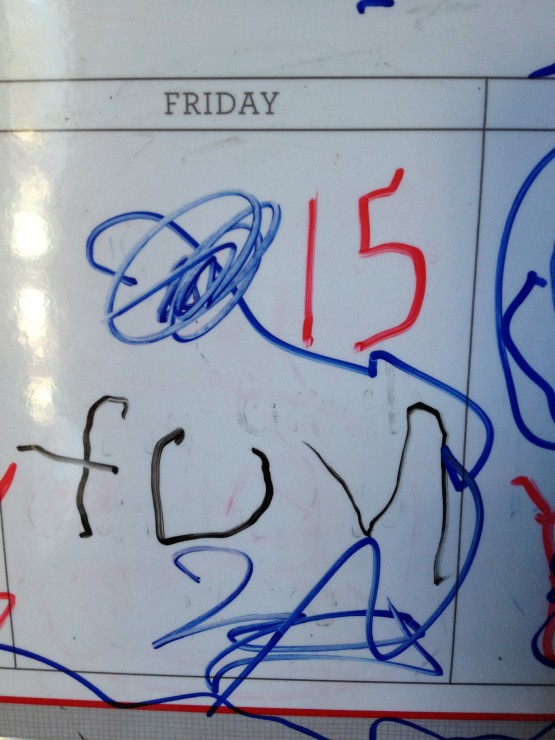
 G has loved the morning calendar routines since day one of her Preschool (for 3 year olds) experience. In fact, the morning routines are about the only part of her school day she’ll tell me about in detail. Because she goes to school 2/3 days a week, we were finding a need for a way for her to keep track of her days home and in school. Or maybe I was just wanting a break from being asked, “Is today a school day, or no?”
Last year, I fell in love with this week-long dry erase calendar the moment I saw it hanging on my friend’s Kindergarten door. She used it to post the week’s events for the families to see. At the time, I thought, “That would be a great way to let G know what she was doing each day (which babysitter’s house, a day off for mom, a party). Then I told myself, “I can make one myself and laminate it, no need to buy one.” Many months later, I broke down and bought it. Of course I never got a chance to make one! It is really one of the best routines we have in the house because it is really useful!
Pros:
- Penmanship practice-lots of chances to write those pesky 2’s!
- Shared writing-sharing the pen to let G do what she can and what she needs some practice on independently while I write the really hard stuff (or the stuff that she’s “too tired” (lazy?) to write.
- Encoding-wonderful opportunities to connect sounds to letters.
- She now understands the cyclical concept of a week a bit better than when she would just do the sing-song about the days of the week that she learned in school.
- She can find the week that she’s up to on a calendar. She also refers to the calendar if she needs help “spelling a number”.
- She can synthesize what she knows about the “real” calendar, the songs the knows about months and days, and the week long calendar to figure out when a month ends and a new one begins.
- It’s creative! G makes up all sorts of days for us to spend together. At first I was nervous that she’d write activities that would be impossible to do. Instead she writes pretty general ideas-“fun”, “paint” and the newly invented “dot day” where you can do just about anything that includes a dot of some kind.
- The best perk is that I don’t have to remind her about what’s happening and when (which used to be a constant job because she can be a pretty stubborn kid).
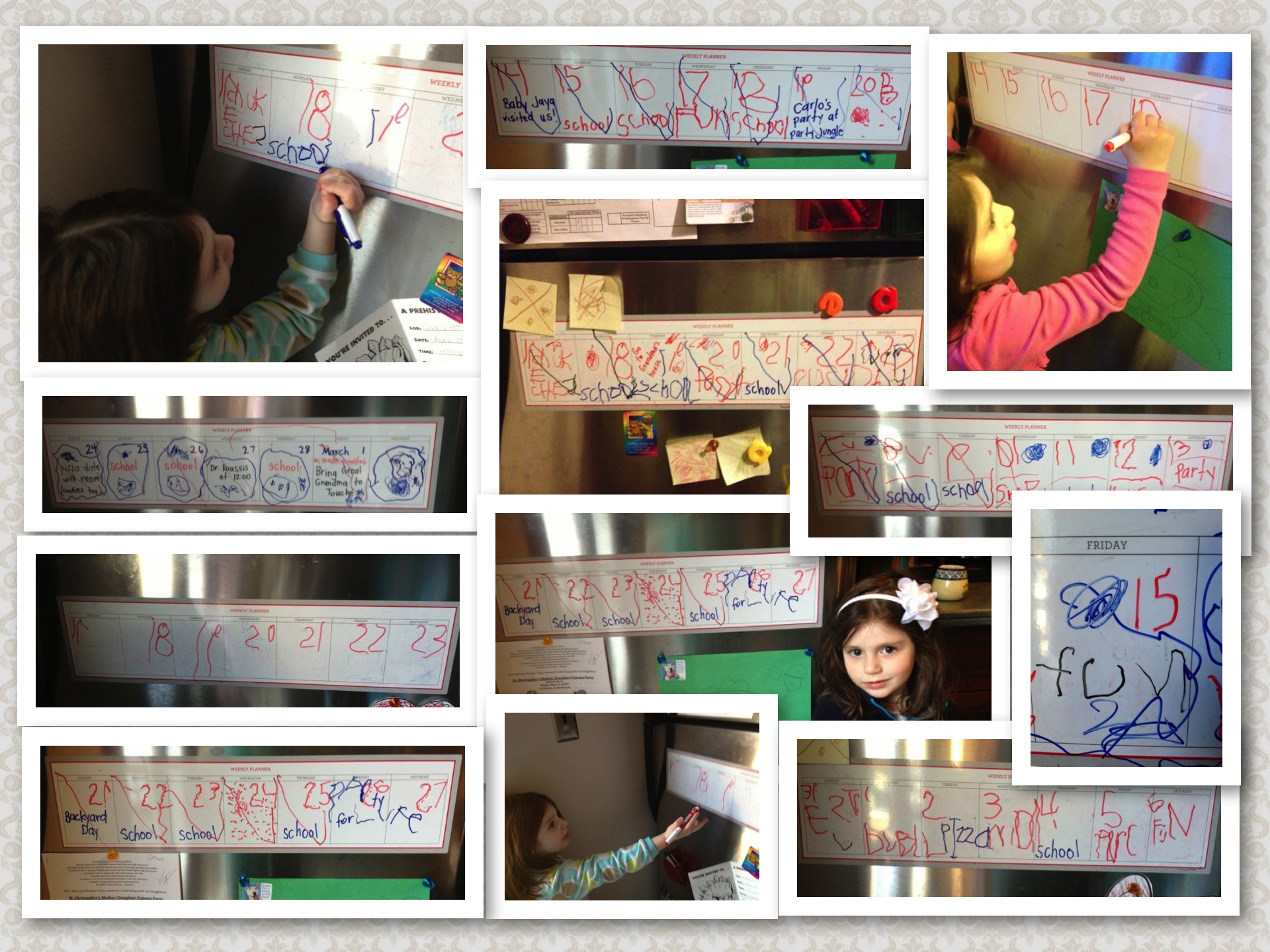
Implications for parents and teachers-
- If you have a “calendar” or “morning” routine, make sure that you are NOT the one doing the work for the children.
- Choose a routine that is meaningful, helpful and developmentally appropriate.
- If the routine becomes a drag, drop it.
- Correct mistakes kids make if the mistake actually matters or if the correction will help the child grow as a learner in the future. For example, I did not correct G when she wrote “parc” for park. As long as she knows what it says, it serves the purpose of why we do this routine. Also, it’s wonderful that she is writing ending sounds on words, so for that reason, the c stays. Now, if she wrote school on the wrong day, I would correct her because it would matter a great deal if we showed up for school on the wrong day.
- Use a calendar the REAL way it’s used. We don’t write the date on a calendar day-by-day, why do it like this in school? Real calendars don’t have patterned shapes on the dates either. It has numbers and events. Keep it simple if you want the kids to learn about why and when the tool of a calendar is useful.

 bigglittleg.com