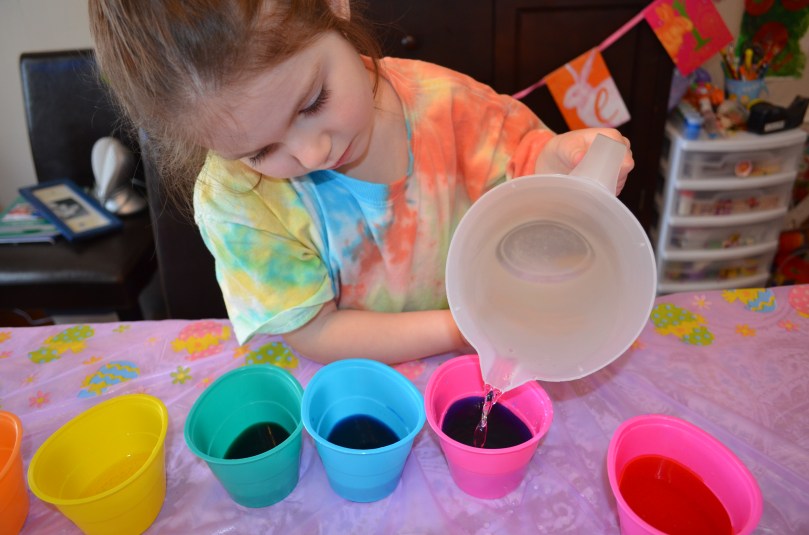
How do 3 year olds learn to read, write, and think “before their time”?

I attended a parent-teacher conference for little g yesterday.  It was her very first one.  She’s only 3 1/2 and sat so still, with her little hands gently folded on her lap and her head slightly lowered for almost the whole conference.  I guess it’s weird when people are talking about you.  She got a good report.  The comparisons started to roll in-She’s just like her sister-easy going, polite, helpful and really knows her stuff.  “I have no complaints”.  :/

So, the light conversation becomes about our family and “how did we do it, twice”.  g’s teacher is a new-again mom.  She has a child that’s a little over a year old and two much older siblings.  Things change and was wondering about how these two girls learned so much at home.

I have been having trouble choosing topics for this blog.  Her question forced me to find the root of the problem.  There is an endless supply of fun learning that goes on here every day, so there should be an endless supply of blog posts, right?

I’ve also been coaching lots of new (to me, not to teaching) teachers.  It’s been wonderful and really has forced me to refine what is important about the learning, teaching and leadership, in mathematics and just in general.

Long story short, I think I figured it out.  It’s not really about the methods I use.  It is so much more about my beliefs about how children learn and grow.  Toni (my forever mentor and coach) taught us early on about this and I feel like I have been digging deep into everyone’s beliefs lately.  This fall, I have embarked on “uncomfortable journeys” with new colleagues that will help all of us learn more about engaging young people in the art of learning.  Just an aside-I view “uncomfortable” as a really positive thing…

So, here are many of my current beliefs.  Hopefully in naming them, I can just throw future posts up here and you might understand where I am coming from.

  1. Children can and will learn a whole lot on their own, as long as learning opportunities are available.
  2. Learning opportunities cannot be either “just-right” or well-designed without:
    • a deep understanding of the content at hand, including how ideas relate to each other, AND,
    • an understanding of about where a child is developmentally.
  3. Time needs to be set aside for learning opportunities that develop ideas well before they need to be used or applied as a strategy independently. (In some cases, I’m talking years!)
  4. If you think about an idea developing over a span of a year or more, little learning opportunities can be tucked into your days constantly.  SO, patience is key.
  5. Teaching kids how to thinkhow to wonder, how to ask questions, how to connect ideas and how to reflect on their thinking-is far more important than telling kids what they should think or how they should apply an idea or strategy.
  6. Autonomy, both social and intellectual, are my ultimate goals for every learner.
  7. Kids learn more effortlessly in the moments that are fun and meaningful.

There is NO POSSIBLE way that the kids would be where they are if I directly taught every single thing that they know to them.  Quite frankly, there is just not enough minutes in the day for that!

To go full circle, and link back to the PT conference, I caught myself saying, “Well, I started to introduce/point out/watch movies with isolated written words as soon as they could sit in the boppy chair.  I just wanted them to know that the words we say can also be written in print and I expected that they would read in about 3 years from then.” I wasn’t sure if I should keep going, but in my usual style, I kept talking…”When I made coffee holding the baby on my hip I’d narrate life like, ‘I am going to make four cups of coffee.  Let’s measure the water.  The water reached the fourth line!  Now let’s put four scoops of coffee into the machine, ready?  1, 2, 3…’I hope that you get the idea.” I’m not quite sure it was the answer she was expecting.

I suppose what I am trying to say is that what and how your kids learn depends on your beliefs about how they will learn and when they expected to actually know things.  I could write numerous posts on this, I guess that’s the simplest way I could say it!

And that’s it.  I’m going to click publish before I change my mind or go back and revise what I’m thinking…there’s no time for that either! Hope to write to you again soon.
Calendar Routines at Home

funG has loved the morning calendar routines since day one of her Preschool (for 3 year olds) experience.  In fact, the morning routines are about the only part of her school day she’ll tell me about in detail.  Because she goes to school 2/3 days a week, we were finding a need for a way for her to keep track of her days home and in school. Or maybe I was just wanting a break from being asked, “Is today a school day, or no?”

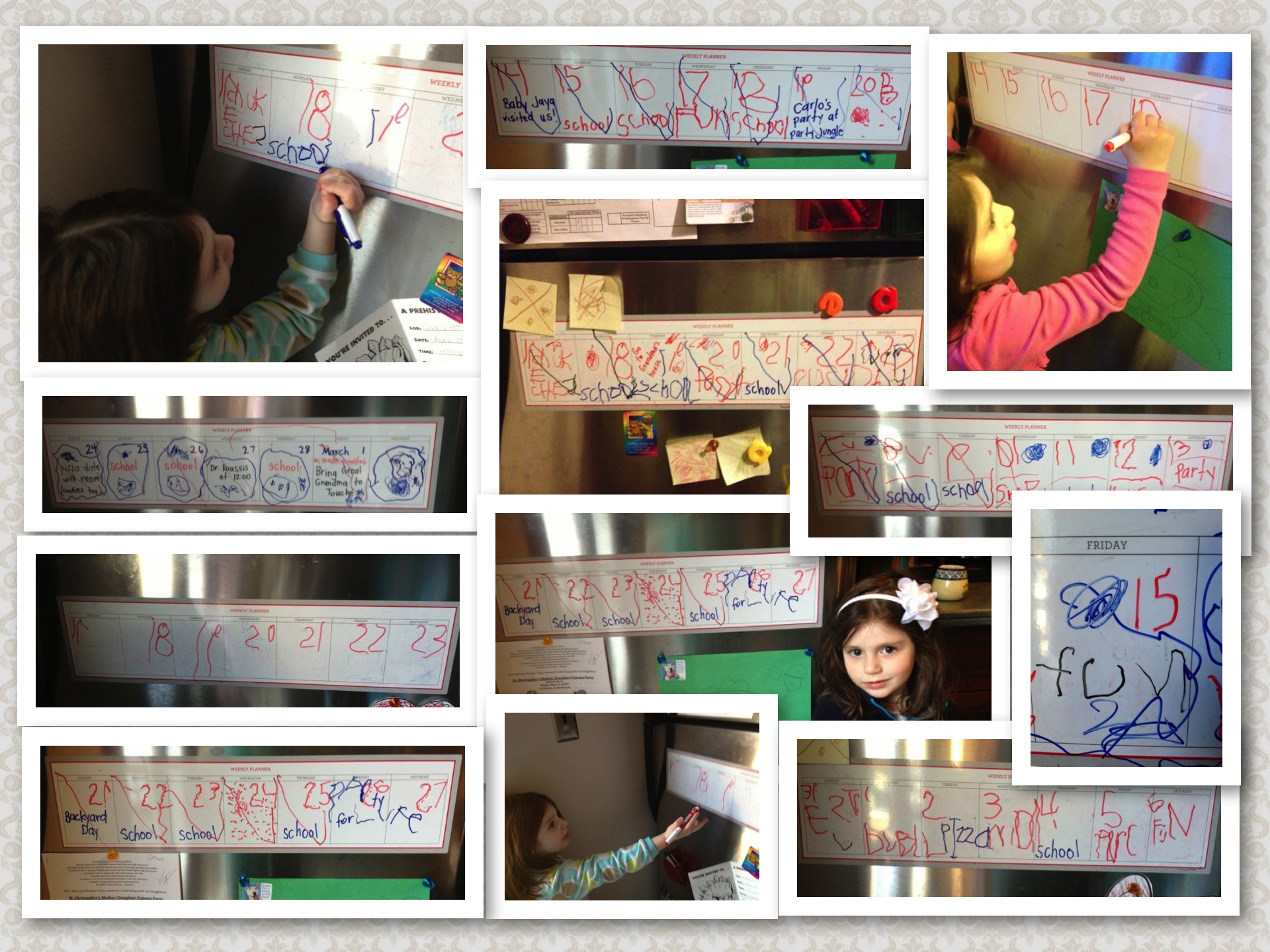
Last year, I fell in love with this week-long dry erase calendar the moment I saw it hanging on my friend’s Kindergarten door.  She used it to post the week’s events for the families to see.  At the time, I thought, “That would be a great way to let G know what she was doing each day (which babysitter’s house, a day off for mom, a party).  Then I told myself, “I can make one myself and laminate it, no need to buy one.”  Many months later, I broke down and bought it.  Of course I never got a chance to make one!  It is really one of the best routines we have in the house because it is really useful!

Pros:

  1. Penmanship practice-lots of chances to write those pesky 2’s!
  2. Shared writing-sharing the pen to let G do what she can and what she needs some practice on independently while I write the really hard stuff (or the stuff that she’s “too tired” (lazy?) to write.
  3. Encoding-wonderful opportunities to connect sounds to letters.
  4. She now understands the cyclical concept of a week a bit better than when she would just do the sing-song about the days of the week that she learned in school.
  5. She can find the week that she’s up to on a calendar.  She also refers to the calendar if she needs help “spelling a number”.
  6. She can synthesize what she knows about the “real” calendar, the songs the knows about months and days, and the week long calendar to figure out when a month ends and a new one begins.
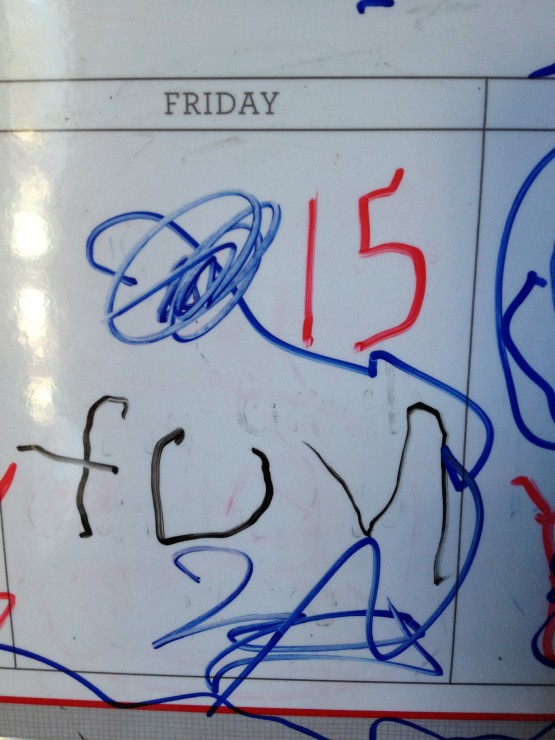
  7. It’s creative!  G makes up all sorts of days for us to spend together.  At first I was nervous that she’d write activities that would be impossible to do.  Instead she writes pretty general ideas-“fun”, “paint” and the newly invented “dot day” where you can do just about anything that includes a dot of some kind.
  8. The best perk is that I don’t have to remind her about what’s happening and when (which used to be a constant job because she can be a pretty stubborn kid).

calendar collage bigger

Implications for parents and teachers-

  • If you have a “calendar” or “morning” routine, make sure that you are NOT the one doing the work for the children.
  • Choose a routine that is meaningful, helpful and developmentally appropriate.
  • If the routine becomes a drag, drop it.
  • Correct mistakes kids make if the mistake actually matters or if the correction will help the child grow as a learner in the future.  For example, I did not correct G when she wrote “parc” for park.  As long as she knows what it says, it serves the purpose of why we do this routine. Also, it’s wonderful that she is writing ending sounds on words, so for that reason, the c stays.  Now, if she wrote school on the wrong day, I would correct her because it would matter a great deal if we showed up for school on the wrong day.
  • Use a calendar the REAL way it’s used.  We don’t write the date on a calendar day-by-day, why do it like this in school?  Real calendars don’t have patterned shapes on the dates either.  It has numbers and events.  Keep it simple if you want the kids to learn about why and when the tool of a calendar is useful.

Remember teachers, as this happens, YOUR jobs are on the line. Think about it.

I really hope that a LOT changes before Big G hits 3rd grade. After proctoring last year’s math exam to 5th graders, I’ve seen enough. Those kids had come so far. I taught them in first grade. I remember how hard they worked to learn how to read and speak English well. I saw how well they overcame so many of the struggles they once had while taking the test. Did this evidence show up in their scores? Not the last time that I checked. I saw the look of defeat on their faces. They worked SO hard and just couldn’t understand why, in their 3rd year of taking state exams, the test becomes harder each time. They knew full well that had done everything they were asked to do up until this point and looked so confused about why they were having such difficulty. All this stress for such in unimportant outcome is so unnecessary. There is NO good information that comes from the data that teachers receive. The scores DO NOT inform their teaching. Their scores DO NOT help them meaningfully group students, understand fully what their struggles are (or even what they are good at). It only tells us about how well they take a test and how likely they are to receive a similar score the next year. And that’s if the test doesn’t change. You may think by what I post that I am against children taking exams. I am not. I am against the weight given to these particular exams. I am against certain administrators in certain schools who tell their teachers to “test prep and then test prep some more” all year long. I was lucky to work in a school community where this was not the case. Even when the best schools try to make the most out of this imposition of testing, the trickle down of anxiety and the development of negative self-worth happens despite a school’s best efforts to protect students from it. I just can’t see any positive benefits to any of it.

Learning Everyday

Learning Everyday

In our family, we learn new stuff all of the time. We talk about it, sing about it, and write about it in an effort to be aware that we grow better every day, especially when the lessons learned are organic and unintentional. Those are the best times! This blog is hopefully just the beginning of:
(1) an effort to document how fun growing and learning can be;
(2) the documentation of the development of my two rock stars, named on this blog as “Big G” and “little g”; and,
(3) to share my thoughts and ideas (admittedly, mostly opinionated) as a mommy-teacher to help your kids be super smart too!