Outdoor Math Game~20 Jump!

IMG_4732 - Version 2

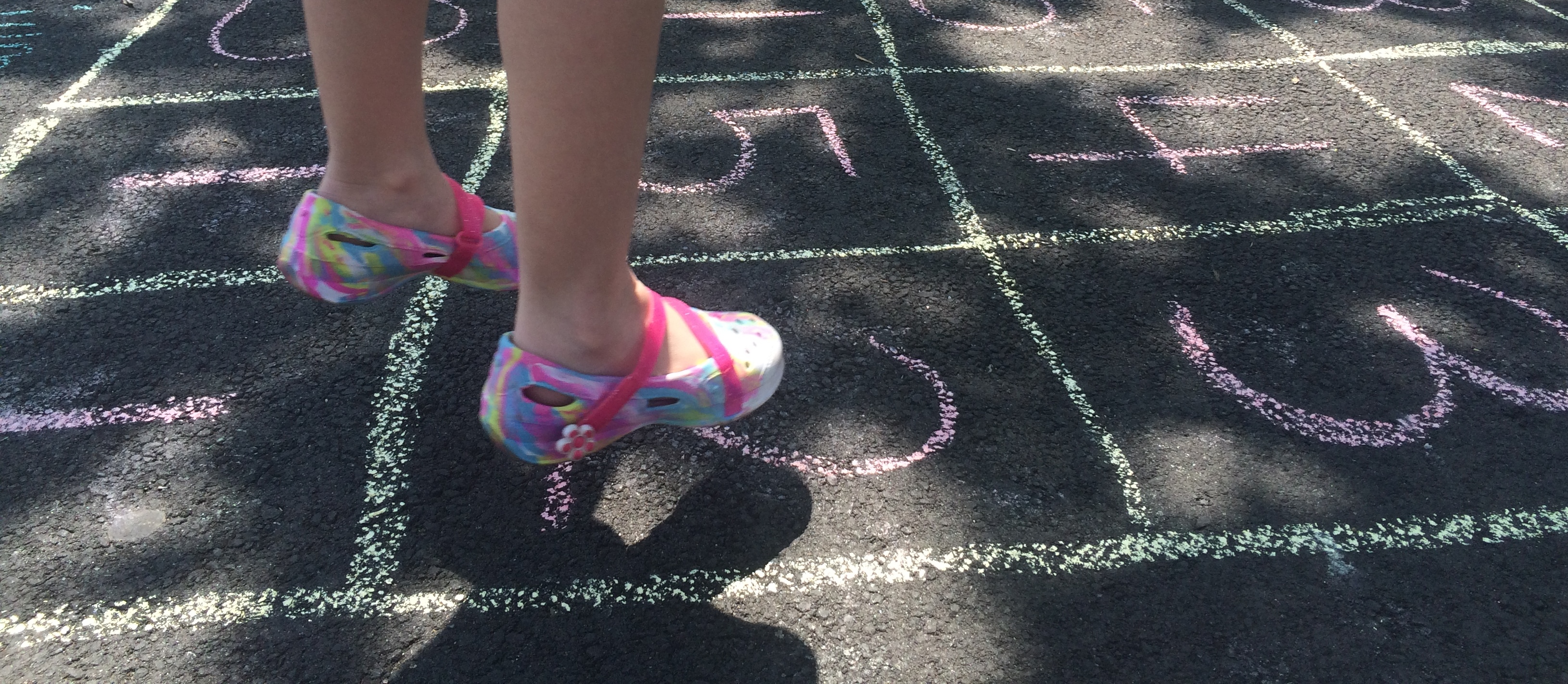
After (un)officially taking this past week off, toward the end of the week I realized that we took it really, really easy in the intentional learning department. Before leaving for the sprinklers on Friday, I decided to sketch out a gameboard that I could recreate on the floor of the park. I lost the little draft, which had some well placed numbers. It didn’t matter much-we still had fun.

IMG_4725 - Version 2

The object of the game is to jump on as many squares as you need, adding on smaller quantities to make 20.  Now, you might be thinking, “Hey, you want me to play this with a Kindergarten kid?”  My response is, “Yep, sure do.”  Here’s why-it’s not meant to be easy.  It’s not meant to be for extra making 10 practice.  It might be practice for a 2nd/3rd grader, which is also good.
My goals here are to have G to:

  • become more fluent with using the making 5s facts;
  • understand the really small quantities (building blocks) that can make up 5s and 10s;
  • use the make ten facts that she knows (she hasn’t learned how useful they can be yet!);
  • think of 20 in different ways (four 5s, or two 10s, or two 5s and two tens); and,
  • to develop strategies to keep track of the jumps (here’s where thinking in 5s and 10s is useful!).

We played a few times.

I went first.  After my turn, she wrote what I did, just because she wanted to.

As predicted, keeping track during her turn was tricky.  As first G started with 1s and 2s and got lost in what she was up to IMG_4728 - Version 2so she started over.  She asked me if I could keep track on the side, so I did this time only.  Here’s how it went down.

She jumped on 2, then 4.  Said, “That’s 6.” Oh, I can jump on another 4!” She hopped over to a 4.

I restated what I saw as I wrote, “So you jumped on 2 and then 4.  That got you to 6, then you saw a 4 and jumped all the way over there!  Why did you want to land on a 4?”

“Cause then I’d get a 10.”

“Hmmm, that’s cool, you can use your make ten facts? Whoa.”

So far I had written:

2 + 4 + 4

Then I said, “So this altogether makes 10?” I wrote parentheses around the expression as I say that.

(2+4+4)

She kept going. She added on as she jumped around.  2. “That’s 12.” 3 “That’ll get me 15.” After much deliberation, she jumped on the 5, seemingly taking the easy way out by then. “A 5 will get me 20.  Write that down!”

I wrote with her, saying that I couldn’t quite remember what she had jumped on.  She remembered, 2 and 3 got me another 5 and then I did a last jump of 5.  So 10 and 10 make 20.”

Yes!  Mission complete.  Now we can play again-I might rearrange the numbers a bit next time, but this was quite effortless and successful!Read More »
App Review! Dreambox and Montessori Crosswords

dreambox
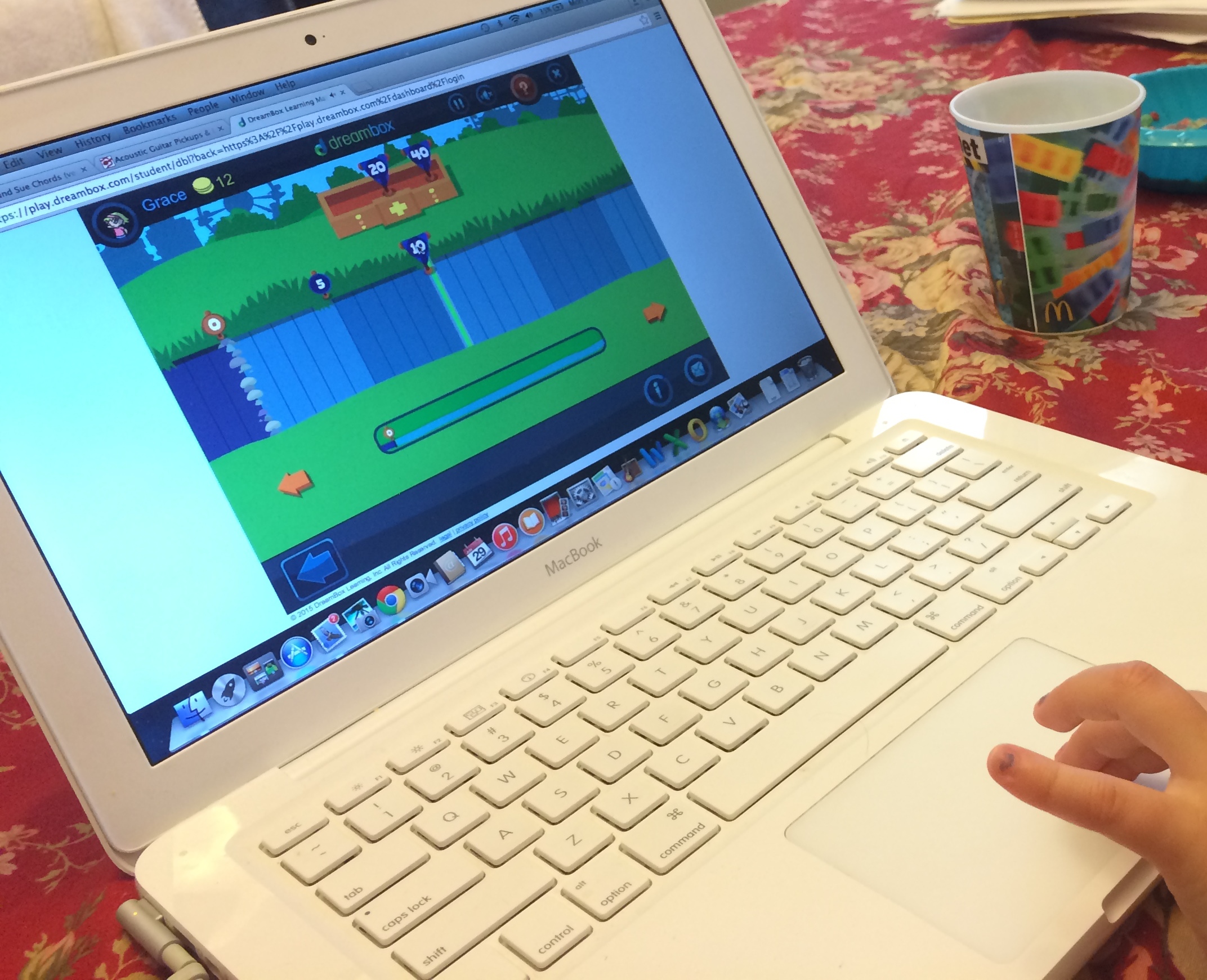
G was excited to get ready for frog-jump racing by placing decade-markers onto the track.

Here are two of our favorite apps-we have many around here.  Although there is current research stating that young children should not use technology, I can’t fight using it.  I love it.  The kids love it.  And they learn a LOT from it.  Everything in moderation, right?  (I hope so-at least I tell myself that letting them use technology is at least better than feeding them non-organic berries.)

Yesterday morning, it was clear that G needed some alone time, which means that little g must do something different.  While G played Dreambox to practice some math, g tried a (new to her) app and LOVED it.  I mean, adored the app.  And, it’s good.

Dreambox.com is a bit pricey, so we turn the subscription on during the summer and when it’s absolutely freezing outside then turn it off at most other times.  What I like about it is that it uses all of the familiar mathematical models that she uses in school, like the rekenrek, 10 frames, closed and open number lines.  It also adapts to your child, so be sure not too help or the program will become too hard for your child to use alone.  You child will need some mouse/trackpad skills for dragging items for sure.  I’m pretty sure that you could use it on an iPad if you have a newer one, ours is too old for it to run.

There is a parent side to the site to let you know how your child is doing.  Here’s how it looks…

Dreambox DashboardWhen she started way back when, we were building really small quantities out of even smaller units, counting or subitizing amounts of objects.  A lot has changed since then.  As your child plays, you might feel like many games seem the same.  What happens is that they are actually changed ever so slightly which is SO important for the gradual release of a scaffold (helper).  There are some great free resources on the teacher page! Try ’em out! http://www.dreambox.com/teachertools

If you want to use the entire program for the summer, you can purchase one month and get one free if I recommend you!  Email your name and email address to dani@bigglittleg.com if you are interested!

Montessori CrossIMG_4363 - Version 2words for $2.99 is a bargain if you ask me.  Basically, it tells you to spell a word, gives you a space for each sound (sort of like an elkonin box), and you can drag the letters in.  You can touch each space so you can hear each sound. While g was playing the game she said, “Wow, see Mom, LOOK!!!  I can spell words!”  She was absolutely proud of what she could do all.by.herself.  Very cool.

As a celebration, there is a super fun design that you can play around with by swishing your finger all over the place before completing the next word.

Starting Summer Reading Off Right…

…by starting immediately.IMG_4333

It’s the first day of summer vacation and yes, we already started the first series for the summer.  Junie B., here we come!  G ended Kindergarten as a pretty strong level L, but her inferencing needs some work.  I wanted to choose a series that was funny, because she needs funny.  And I wanted her to feel connected with the character-one who is pretty opinionated and outspoken-just like G is.  But, here, in this series, Junie B. is outspoken in school(Hubba wha?) G is certainly not the same kind of kid in school as she is out of school it seems.  Which is really the norm from my experience, but it really bothers me!

The series is a level M, which means that she will need support.  I read the first half of first book aloud, and now I feel like I have a sore throat, but I could tell that it was worth it, and she is totally into it.  What’s cool is that the book has 3 paper dolls, which I was reminded, “could be used to act out the stories after we read them”.  And we will.

Fun posts about what we do with the series to boost comprehension to come.  Happy summer reading!  What books will you choose?

Calendar Routines at Home

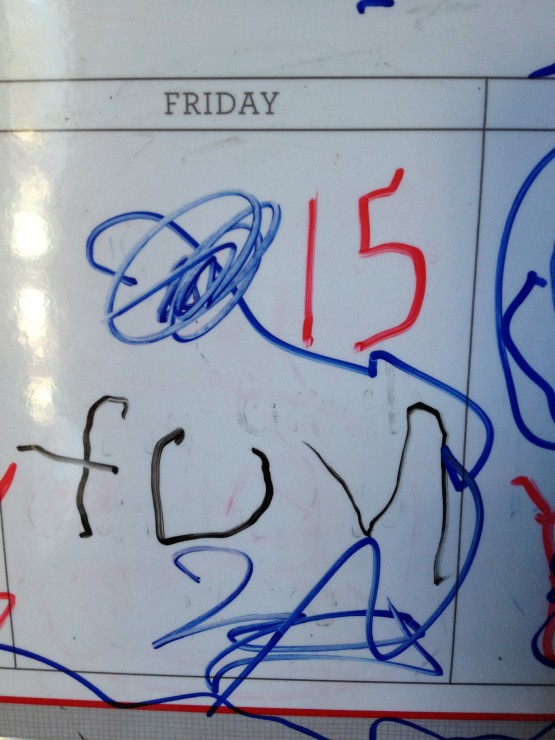
funG has loved the morning calendar routines since day one of her Preschool (for 3 year olds) experience.  In fact, the morning routines are about the only part of her school day she’ll tell me about in detail.  Because she goes to school 2/3 days a week, we were finding a need for a way for her to keep track of her days home and in school. Or maybe I was just wanting a break from being asked, “Is today a school day, or no?”

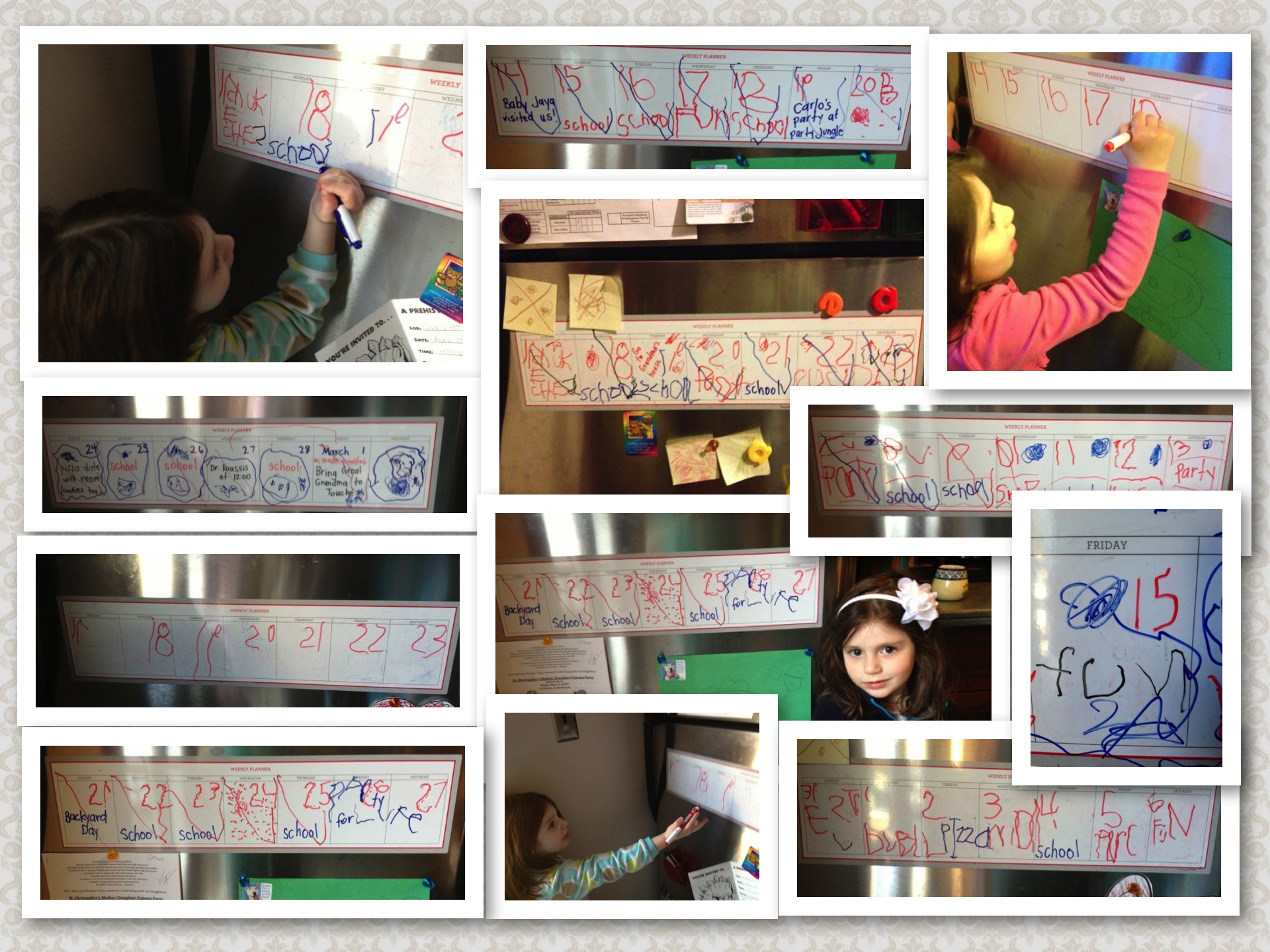
Last year, I fell in love with this week-long dry erase calendar the moment I saw it hanging on my friend’s Kindergarten door.  She used it to post the week’s events for the families to see.  At the time, I thought, “That would be a great way to let G know what she was doing each day (which babysitter’s house, a day off for mom, a party).  Then I told myself, “I can make one myself and laminate it, no need to buy one.”  Many months later, I broke down and bought it.  Of course I never got a chance to make one!  It is really one of the best routines we have in the house because it is really useful!

Pros:

  1. Penmanship practice-lots of chances to write those pesky 2’s!
  2. Shared writing-sharing the pen to let G do what she can and what she needs some practice on independently while I write the really hard stuff (or the stuff that she’s “too tired” (lazy?) to write.
  3. Encoding-wonderful opportunities to connect sounds to letters.
  4. She now understands the cyclical concept of a week a bit better than when she would just do the sing-song about the days of the week that she learned in school.
  5. She can find the week that she’s up to on a calendar.  She also refers to the calendar if she needs help “spelling a number”.
  6. She can synthesize what she knows about the “real” calendar, the songs the knows about months and days, and the week long calendar to figure out when a month ends and a new one begins.
  7. It’s creative!  G makes up all sorts of days for us to spend together.  At first I was nervous that she’d write activities that would be impossible to do.  Instead she writes pretty general ideas-“fun”, “paint” and the newly invented “dot day” where you can do just about anything that includes a dot of some kind.
  8. The best perk is that I don’t have to remind her about what’s happening and when (which used to be a constant job because she can be a pretty stubborn kid).

calendar collage bigger

Implications for parents and teachers-

  • If you have a “calendar” or “morning” routine, make sure that you are NOT the one doing the work for the children.
  • Choose a routine that is meaningful, helpful and developmentally appropriate.
  • If the routine becomes a drag, drop it.
  • Correct mistakes kids make if the mistake actually matters or if the correction will help the child grow as a learner in the future.  For example, I did not correct G when she wrote “parc” for park.  As long as she knows what it says, it serves the purpose of why we do this routine. Also, it’s wonderful that she is writing ending sounds on words, so for that reason, the c stays.  Now, if she wrote school on the wrong day, I would correct her because it would matter a great deal if we showed up for school on the wrong day.
  • Use a calendar the REAL way it’s used.  We don’t write the date on a calendar day-by-day, why do it like this in school?  Real calendars don’t have patterned shapes on the dates either.  It has numbers and events.  Keep it simple if you want the kids to learn about why and when the tool of a calendar is useful.